A discipline for governed knowledge
Know what you know. And prove it.
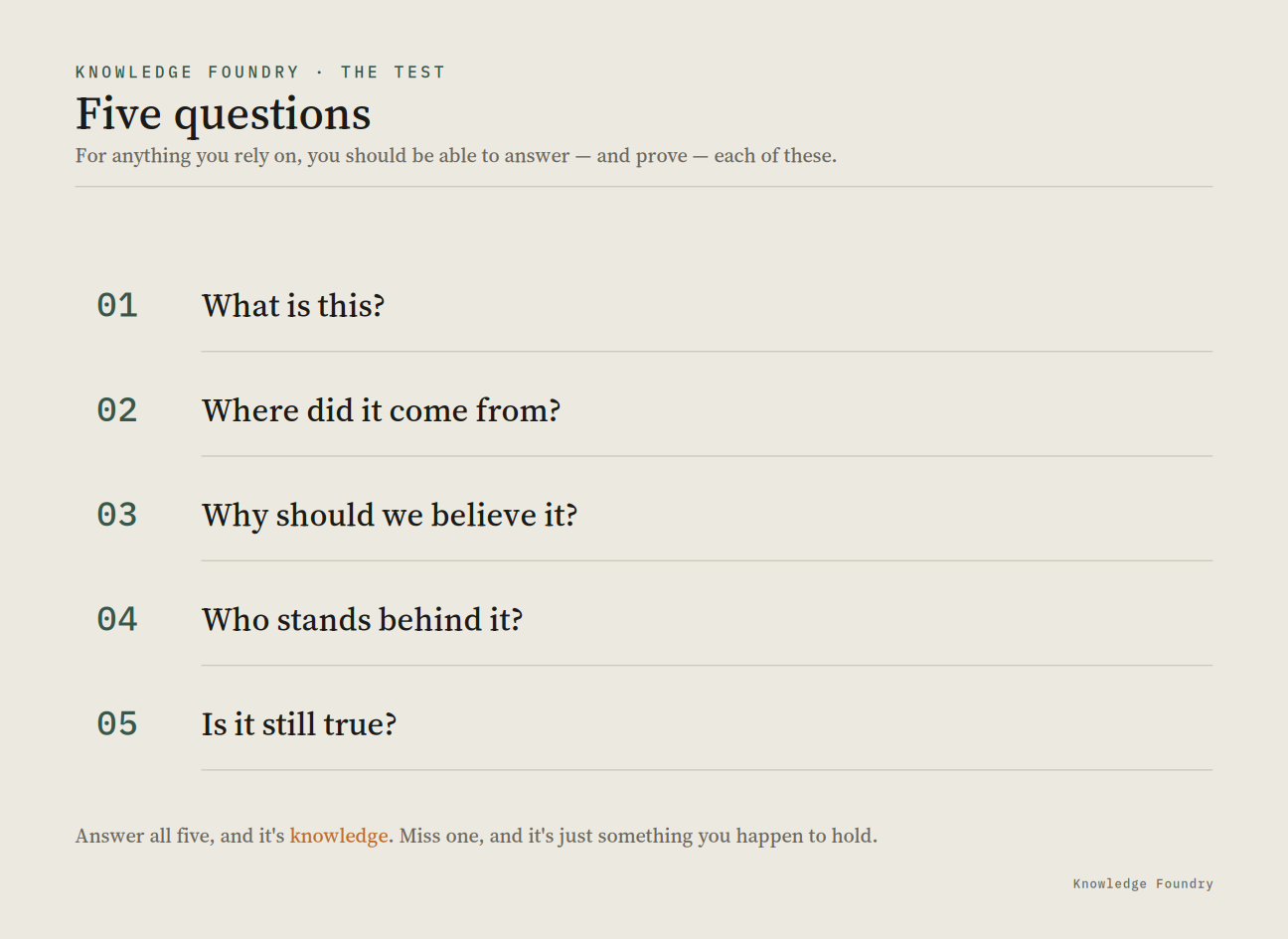
In the age of AI, the signals we used to trust — where a claim came from, who stands behind it, whether it still holds — are disappearing. Knowledge Foundry is a discipline for governing knowledge so that what people, institutions and machines reason from stays traceable, accountable and sound.
The problem
More information. Less trust.
Generative AI produces fluent, plausible content instantly — and strips away the provenance and authorship that once told us what to believe.
For thirty years we made our documents, processes and data legible to machines. The layer that actually carries our knowledge — judgement, evidence, the difference between a correct answer and a defensible one — was never built to be governed. A system is only as sound as the knowledge beneath it, and ungoverned knowledge does not scale; it multiplies error, confidently.
The gap is not the machine's ability to answer. It is our inability to say where an answer came from, why it should be believed, and who is accountable for it. That is a gap in governance, not technology.
The idea
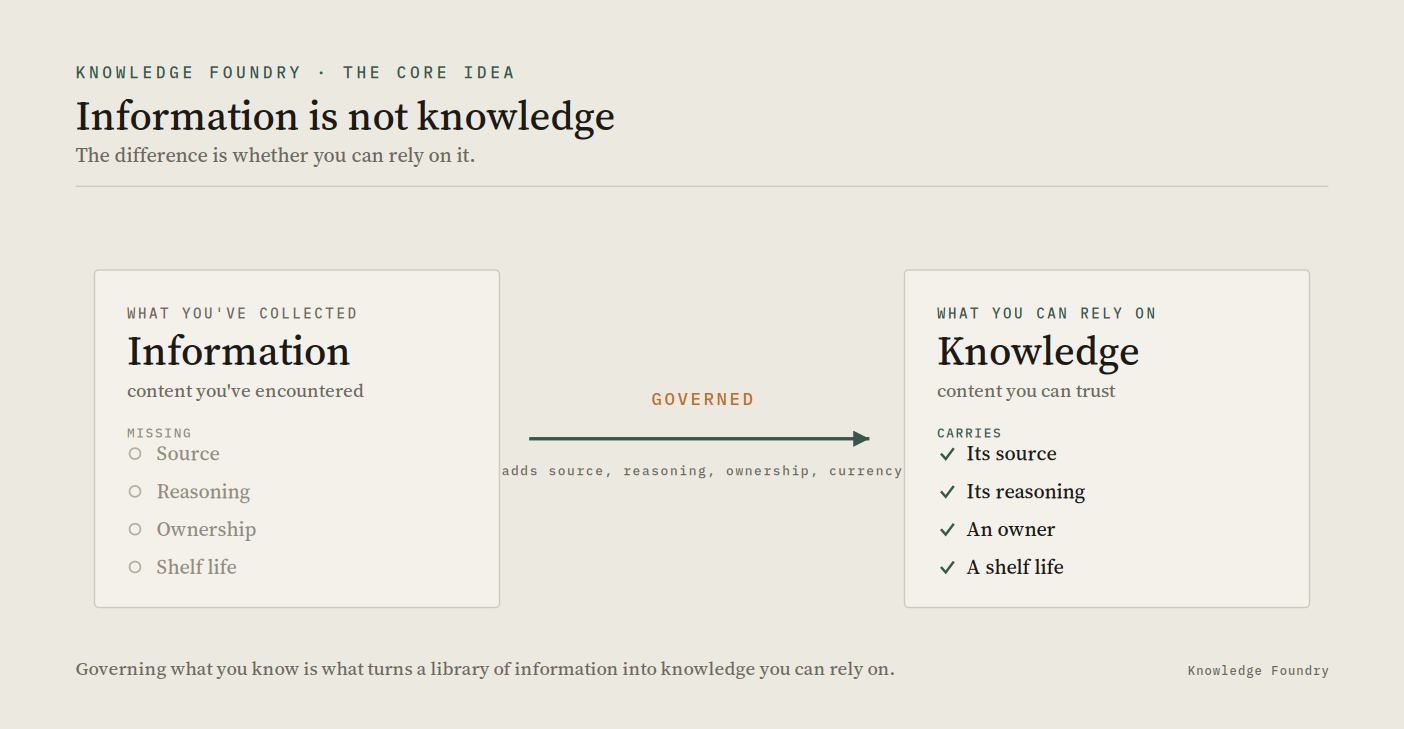
Information is not knowledge.
Knowledge worth relying on has been examined, justified and accepted by someone accountable — and it changes under control.
Knowledge Foundry treats it as a governed object with a life: an origin, evidence, a reasoned justification, an authority who accepts it, and a recorded history of change. Rigour matches the stakes — a working note is held lightly; a board decision is held to account. And it is honest by design: counter-evidence stays attached, and a claim's standing is stated plainly.
Why believe it
Rigour you can inspect.
Derived from evidence
Built from mature traditions — knowledge engineering, knowledge management, records governance, AI. Not invented from scratch.
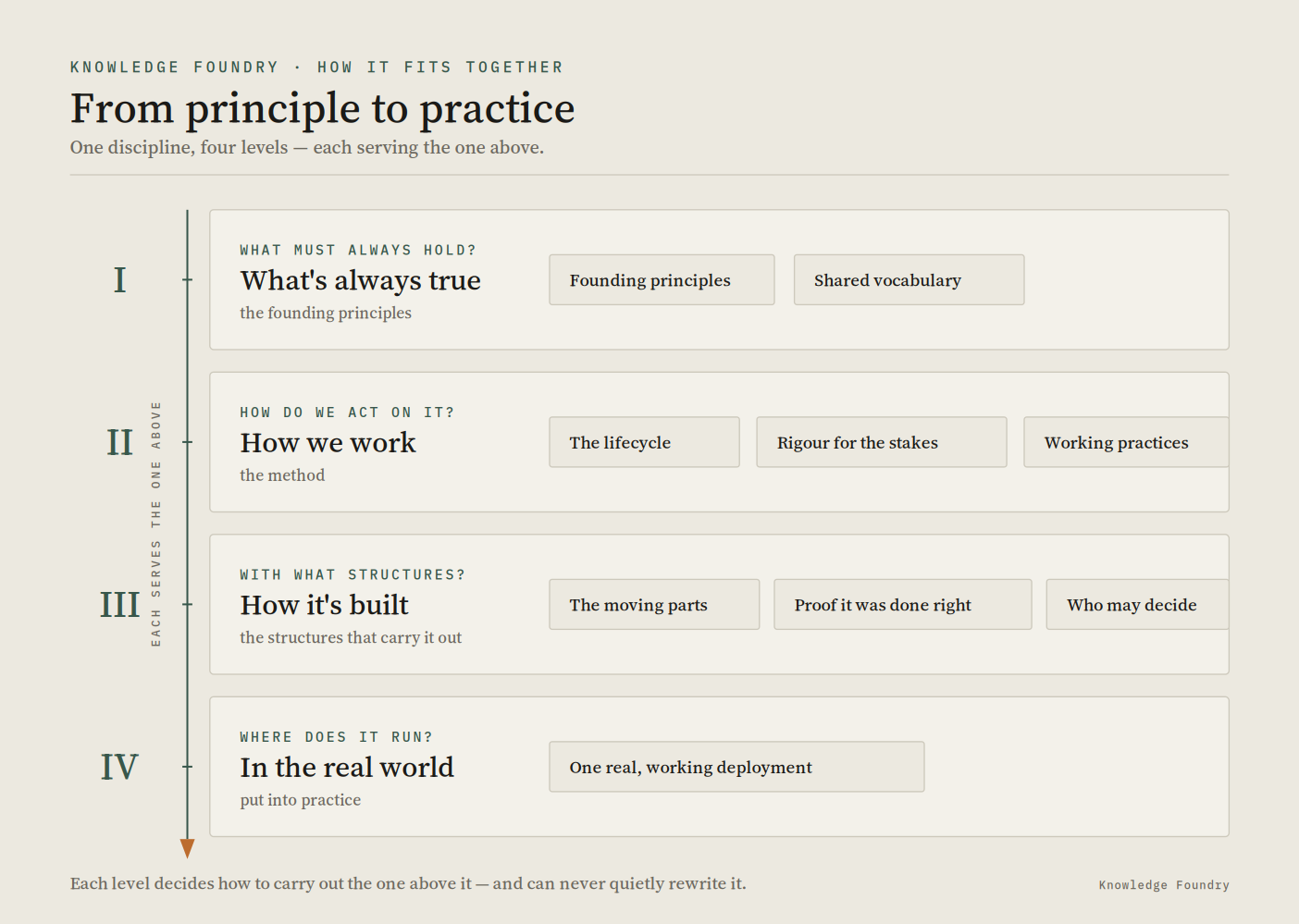
A full reference architecture
Set out end to end, from the principles that never change to the tests that prove an implementation honours them.
A worked example
One ordinary decision, governed from first question to final call — in plain English any professional understands.
Domain-independent
The same discipline governs an HR policy, a clinical note, a research finding or a strategy. The subject changes; the architecture does not.
Who it is for
Built for anyone who holds knowledge to account.
For professional associations
A credible, non-vendor account of how your members create, validate and rely on knowledge — now that AI is in every workflow. Ready to shape into guidance, CPD and conference material the whole profession can adopt.
A standard for how your profession knows →For educational institutions
A rigorous, teachable account of how a claim earns the right to be relied upon — directly relevant to academic integrity and research provenance in the age of AI. Ready as a module, a framework, or a research collaboration.
How knowledge becomes trustworthy →For self-directed learners
The discipline works at the scale of one: turn what you read into knowledge you can trust — and keep it. Free to read, nothing to buy.
A discipline for your own knowledge →A worked example
Should we move to a four-day week?
Watch a good decision get made — from first question to final call, and back again when the evidence changes.
The question is posed and the evidence gathered — real trials, real counter-evidence. Each source is weighed. A reasoned case is written, its assumptions stated and its limits admitted: warranted for a trial, not yet for permanent adoption. An authority accepts it for a defined use; it informs the decision, is monitored, is revised when the trial reports, and is eventually folded into a broader policy. Nothing is erased — the whole history can be reconstructed. Swap the subject for a clinical guideline or a research finding and every step is the same. That is the point.
The stance
We do not make more information. We make knowledge you can trust.
A discipline and reference architecture, in the hands of professional associations and educational institutions — and, in time, the foundation for governed implementations, built profession by profession.
Read
The work, in full and in brief.
Everything is open. Read the short version to understand the idea, or the complete reference architecture to see it entire.